


As artificial intelligence moves from specialized software into core enterprise workflows, logistics and finance leaders face an operational temptation: automate the entire transportation invoice lifecycle from receipt to disbursement.
On paper, fully autonomous freight payment sounds ideal. High invoice volumes, complex accessorial charges, multi-currency transactions, and disparate bill-of-lading documents seem tailor-made for machine learning models.
However, releasing funds to a carrier is an immutable financial transaction.
While AI excels at pattern recognition, unstructured data extraction, and anomaly detection, it lacks legal accountability, contextual intuition, and strict deterministic logic. Treating machine learning as an ultimate financial decision-maker rather than an intelligence engine exposes global supply chains to unrecoverable cost leakage, regulatory non-compliance, and distorted general ledger posting.
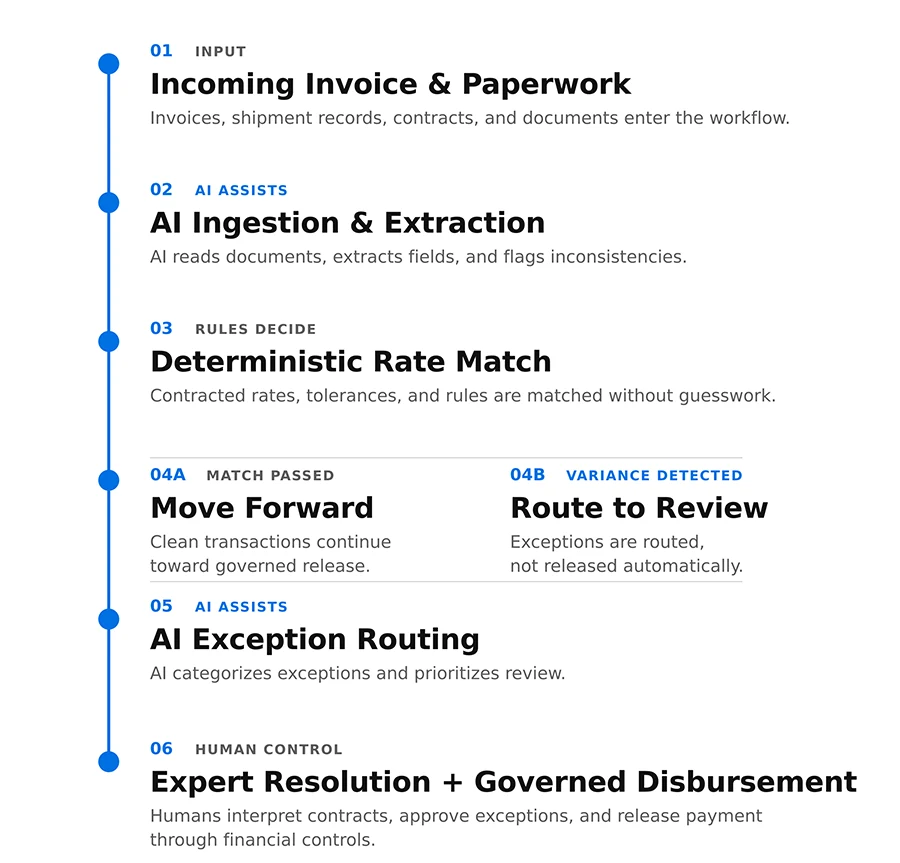
Building a resilient audit structure requires a clear boundary: leverage AI to process data rapidly, but reserve final financial decision authority for deterministic rules and human governance.
1. Machine Learning Is Probabilistic; Financial Audit Must Be Deterministic
At its core, artificial intelligence operates on probabilities. A model estimates the likelihood of a match based on historical training data.
Financial auditing cannot operate on likelihoods. An invoice amount either matches the contracted tariff, rate card, and bill of lading, or it does not. A value-added tax (VAT) calculation is either legally compliant for that jurisdiction, or it is non-compliant.
| Operational Layer | Model Type | Functional Execution |
| Data Ingestion & Extraction | Probabilistic (AI / ML) | Contextual reading of non-standard PDFs, bill-of-lading documents, and unstructured accessorial notes. |
| Rate & Tax Validation | Deterministic (Rule-Based) | Exact mathematical verification against active contracts, tariffs, fuel surcharges, and local tax laws. |
| Disbursement Authorization | Governed (Human / Rule) | Strict execution of approval hierarchies, bank routing controls, and compliance checks. |
Relying on AI to “guess” whether an ambiguous accessorial fee matches a contract clause introduces compounding financial drift. AI should structure the data; deterministic software engines must validate the numbers.
2. Where AI Should Make (or Drive) Decisions
When constrained to data processing, pattern identification, and workflow routing, AI provides massive scale and precision.
Unstructured Document Extraction
Freight invoices arrive in hundreds of formats across global ocean, air, rail, and motor carriers. AI-driven optical character recognition (OCR) and natural language processing (NLP) extract line-item charges, container numbers, currency markers, and bill-of-lading references without requiring rigid, carrier-specific templates.
Anomaly and Fraud Detection
Machine learning algorithms excel at evaluating real-time invoice streams against deep historical baselines. AI can flag subtle anomalies that traditional static rules miss, such as:
- Sudden spikes in accessorial charge frequencies from a specific origin terminal.
- Outlier fuel surcharge logic applied across specific regional lanes.
- Sequential invoice numbering patterns that signal potential duplicate billing attempts across multiple subsidiaries.
Predictive Exception Routing
When an invoice fails validation, traditional systems often dump the exception into a generic queue. AI can evaluate the exception root-cause, identify the exact missing document (e.g., missing proof of delivery or tax ID), and auto-route the file to the specific regional analyst, carrier rep, or internal buyer best equipped to resolve it.
3. Where AI Should Never Make Autonomous Decisions
Delegating financial release or contract interpretation to AI introduces severe enterprise vulnerabilities.
4. Final Payment Authorization and Cash Disbursement
AI should never hold the “digital pen” that releases funds from a bank account. If an AI model hallucinating a match approves an incorrect invoice, recovering paid funds from overseas carriers is costly and often impossible. Final execution must require hard deterministic rules or authorized human approval.
5. Legal Contract and Accessorial Interpretation
Contracts contain nuances, volume tier thresholds, and conditional clauses that AI can misinterpret. If a contract states that detention charges apply only after a specific free-time window calculated from vessel berth, not arrival at anchor, an AI model may misread the operational context and approve invalid carrier penalties.
6. Tax Classification and Legal Entity Allocation
Tax compliance is non-negotiable. A global transaction requires strict adherence to local GST/VAT rules, withholding requirements, and legal entity accounting codes. AI cannot be permitted to autonomously assign tax categories or reallocate expenses across corporate entities without validated system mappings.
7. Building an AI-Augmented Governance Model
To maximize speed without risking financial integrity, global logistics leaders implement an AI-augmented workflow.
| Task Category | AI Role | Human / Engine Role |
| Data Normalization | Converts raw carrier invoices into standardized data definitions. | Governs standard data definitions and structural mappings. |
| Contract Verification | Compares extracted invoice data against tariff databases. | Maintains rate tables, contract amendments, and tolerance thresholds. |
| Exception Resolution | Identifies likely root cause and compiles supporting documents. | Reviews financial impact, negotiates disputes, and authorizes credits. |
| ERP Posting | Formats valid transactions for general ledger distribution. | Defines chart-of-accounts rules, cost-center assignments, and audit trails. |
Questions to Ask Before Applying AI to Transportation Finance
- Does our platform use AI for data extraction and anomaly detection, or is it making unverified payment approvals?
- How does the system handle low-confidence AI extractions when processing multi-currency or tax-heavy invoices?
- Can every AI-assisted exception resolution be traced back to a human-verifiable audit log?
- Are contract rate validations governed by hard mathematical rules rather than probabilistic models?
- Does our global freight audit architecture preserve local financial context while scaling automation?
Predictive Intelligence with Absolute Financial Control
Artificial intelligence is an extraordinary force multiplier for global logistics finance, but it is not a substitute for financial governance. The most effective supply chain organizations do not hand over their bank accounts to algorithms. They use AI to eliminate manual data entry, spot obscure risk patterns, and accelerate exception workflows while relying on hard rules and experienced professionals to safeguard cash flow.
That is the foundation of true Transportation Financial Intelligence: leveraging modern artificial intelligence to deliver speed and scale, backed by the uncompromising control required to protect the enterprise bottom line.
Frequently Asked Questions
Can AI completely automate freight invoice processing?
AI can automate up to 90% of data extraction, document classification, and anomaly detection. However, final payment authorization, contract dispute resolution, and regulatory tax compliance should remain governed by deterministic rules and human specialists.
What is the primary risk of using unguided AI in freight payment?
The biggest risk is probabilistic financial leakage. Because AI works on probabilities, it can false-positive an invalid rate or accessorial charge as “correct,” authorizing payments that are difficult to recover once disbursed.
How does AI improve freight exception management?
Rather than leaving out-of-tolerance invoices in massive manual queues, AI categorizes the specific discrepancy (e.g., rate mismatch, missing proof of delivery, or tax code error) and automatically routes the file to the responsible party along with suggested resolution data.
In conclusion:
Automating your transportation spend should never mean sacrificing financial control. nVision Global pairs cutting-edge automated processing and machine learning analytics with governed audit engines and in-country financial expertise, giving you enterprise-wide visibility without financial risk.