


Freight audit and payment has often been viewed as a back-office process. For many companies, the goal was simple: review transportation provider invoices, identify errors, resolve discrepancies, and make sure payments were processed correctly.
That work still matters. In fact, it may matter more than ever. But the role of freight audit and payment has changed.
Today, freight audit is no longer just about recovering overcharges after they happen. It is becoming a financial control function that protects margin, improves visibility into transportation spend, supports better forecasting, and gives leadership greater confidence in the numbers behind one of the company’s largest operating expenses.
For enterprise shippers, transportation spend is too large, too complex, and too volatile to treat as a transactional process alone. Every invoice contains financial signals. Every exception creates potential exposure. Every dispute, surcharge, accessorial, rate mismatch, or documentation gap can affect cost, reporting accuracy, accruals, and business decisions.
That is why freight audit and payment must now be viewed through a broader financial lens.
Transportation Spend Is a Financial Control Issue
Transportation costs move through the business in many ways. They impact cost of goods sold, operating budgets, customer profitability, cash flow, accruals, margin analysis, and procurement strategy. Yet for many companies, the data behind those costs is fragmented across systems, locations, modes, regions, business units, and transportation providers.
That creates risk.
When freight invoices are not properly validated, companies may pay incorrect charges. When accessorials are not clearly reviewed, unexpected costs can become normalized. When contracted rates are not consistently matched against actual invoice charges, savings negotiated by procurement may never fully materialize. When data is incomplete or inconsistent, finance teams may struggle to trust the numbers used for reporting and forecasting.
In that environment, freight audit becomes much more than invoice review. It becomes a control point.
A strong freight audit and payment program helps ensure that transportation spend is accurate, documented, governed, and connected to the financial processes that depend on it. It creates structure around a cost category that is constantly changing and often difficult to manage.
The Old View: Find Errors and Recover Money
Historically, freight audit was often measured by how much money it recovered. Duplicate invoices, incorrect rates, misapplied discounts, invalid accessorials, fuel surcharge errors, and service-level mismatches were identified and disputed. The value was easy to understand: find the overcharge, prevent the payment, or recover the funds.
That remains an important part of the process. But recovery alone is not enough.
A recovery-focused model is reactive by nature. It addresses problems after they have already entered the system. It may correct individual invoices, but it does not always help the organization understand why those errors are happening, where they are concentrated, which business units are most affected, or how they connect to broader transportation strategy.
Modern freight audit must go further.
The real value is not only in identifying what went wrong. It is in creating the controls, data discipline, and visibility needed to prevent recurring issues, improve decision-making, and strengthen financial confidence across the organization.
The Numbers Behind the Risk
The need for freight audit is not theoretical. Across all transportation modes and global regions, nVision Global routinely identifies billing discrepancies during the audit process. Depending on the transportation mode and region, discrepancies are found on approximately one out of every 23 invoices to as many as one out of every 6 invoices submitted for audit. Overall, nVision’s historical experience is approximately one finding for every 10 invoices audited.
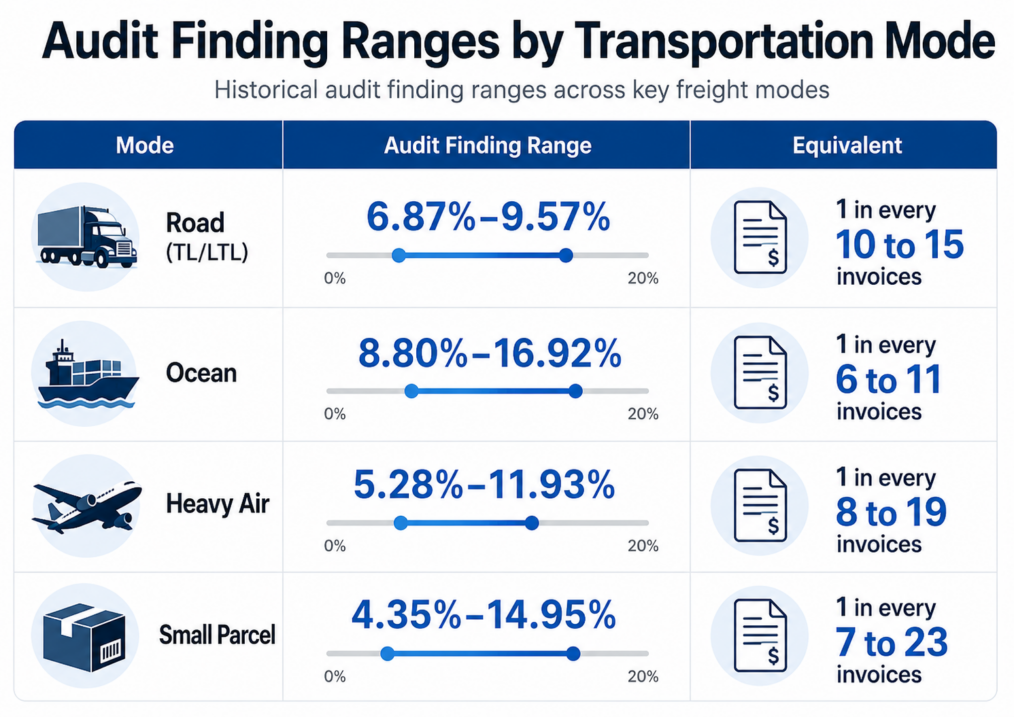
These findings help explain why freight audit and payment has historically been so important. They also show why the discipline is expanding. Each discrepancy is not only a potential recovery or prevention opportunity; it is also a data point that can reveal patterns by carrier, lane, mode, region, business unit, accessorial type, contract term, or approval process.
The New View: Protect Margin and Improve Confidence
In today’s transportation environment, costs can shift quickly. Fuel volatility, changing demand, capacity constraints, accessorial growth, global disruption, regulatory changes, and transportation provider variability can all create financial pressure.
Small invoice errors may not appear significant on their own. But across thousands or millions of shipments, small errors become real money. A misapplied surcharge, an incorrect rate table, a duplicate charge, or an unchallenged exception can quietly erode margin over time.
nVision Global’s financial control and governance metrics reinforce that point. The company’s 9.55% average audit finding rate means that approximately one in every 10 invoices contains at least one billing discrepancy. Across all transportation modes and global regions, the average financial adjustment per audit finding is $183.54, and in 2025, nVision identified more than $360 million in transportation financial adjustments.
This is where freight audit becomes a margin protection function.
By validating freight invoices before payment, companies can reduce leakage and improve control over transportation spend. By organizing invoice-level data into accurate reporting, they can better understand cost trends, provider performance, accessorial exposure, and budget variance. By connecting freight data to finance, procurement, and supply chain decisions, they can move from reacting to spend toward actively managing it.
The result is not just cleaner invoices. The result is greater confidence.
Finance can trust the transportation numbers used in reporting. Procurement can evaluate whether negotiated savings are actually being realized. Supply chain leaders can see where cost exceptions are occurring. Executives can make decisions based on validated data rather than disconnected estimates.
Freight Data Has Financial Data
Freight invoices are often treated as payment documents. But they are also data assets.
Each invoice can contain shipment details, origin and destination information, service levels, modes, weights, zones, rates, discounts, surcharges, accessorials, taxes, duties, provider information, payment terms, and exception details. When that information is captured, validated, standardized, and analyzed, it becomes a source of transportation financial intelligence.
But that intelligence depends on the quality of the data.
If invoice data is inaccurate, incomplete, or inconsistent, the reporting built on top of it will be unreliable. If data is not governed properly, different teams may use different numbers to answer the same financial questions. If upstream processes are not controlled, downstream reporting and analytics become harder to trust.
That is why freight audit and payment plays such an important role.
It sits at the intersection of transportation execution, financial accuracy, provider compliance, and business intelligence. It is one of the few areas where operational activity and financial truth can be reconciled at the transaction level.
Better Controls Create Better Decisions
A modern freight audit and payment program should help answer important business questions, including:
- Are we paying according to our contracted rates?
- Which transportation providers, lanes, modes, or regions are creating the most exceptions?
- Where are accessorial charges increasing
- Are negotiated savings being captured?
- Are certain locations or business units driving unexpected costs?
- Are payment processes aligned with internal financial controls?
- Do finance, procurement, and logistics have access to the same trusted transportation spend data?
These questions go beyond invoice processing. They support financial governance.
The stronger the freight audit process, the stronger the company’s ability to understand and manage transportation spend. Clean data leads to better reporting. Better reporting leads to better decisions.
Better decisions lead to improved financial outcomes.
That is the larger opportunity. Audit findings can identify more than overcharges; they can point to cost reduction opportunities, contract improvement opportunities, procurement opportunities, provider performance opportunities, process improvement opportunities, compliance and governance opportunities, customer service opportunities, and working capital opportunities.
Automation Helps, but Governance Matters
Technology has transformed freight audit and payment. Automation, OCR, EDI, APIs, business rules, machine learning, and analytics can all improve speed, scale, and accuracy.
But technology alone does not create control.
The value comes from how technology is applied. Freight audit requires clear rules, accurate rate data, provider compliance, exception workflows, documentation standards, reporting discipline, and experienced professionals who understand the realities of transportation billing.
AI and automation can help identify patterns, flag anomalies, process documents, and improve efficiency. But those tools must operate within a governed framework. Without strong controls, automation can simply move bad data faster.
That is why the future of freight audit is not automation alone. It is automation supported by governance, expertise, and financial discipline.
The operational metrics matter because they show how technology and governance work together. nVision Global reports:
- 99.3% nSure AI Data Capture Accuracy
- 94.4% Automated Audit Success Rate
- 93.4% Fully Automated Processing with no manual intervention required
- 98.7% Successful EDI Transmission Rate
- 99.1% System Availability YTD
- 93.8% First-Pass Processing Success
- 96.8% Invoice Documentation Compliance
These numbers are not just technology statistics. They support the broader financial control environment by improving data capture quality, processing consistency, documentation discipline, EDI reliability, and workflow confidence.
Freight Audit as a Strategic Business Function
As transportation networks become more complex, the expectations placed on freight audit and payment will continue to grow.
Companies need more than invoice processing. They need accurate financial data. They need visibility into cost drivers. They need controls that reduce leakage. They need confidence that transportation spend is being reviewed, validated, and managed properly.
That shift changes the role of freight audit.
It is no longer just a service that helps accounts payable process invoices. It is a strategic function that supports finance, logistics, procurement, and executive leadership. It helps turn transportation spend into trusted business intelligence.
For companies managing significant freight spend, this evolution is not optional. Transportation costs are too important to leave unmanaged, unvalidated, or disconnected from financial decision-making.
The Bottom Line
Freight audit and payment has become a financial control function because transportation spend has become too complex and too financially significant to manage reactively.
The companies that treat freight audit as a simple transactional process may continue to find and correct individual invoice errors. But the companies that treat it as a control function will gain something more valuable: cleaner data, stronger governance, better visibility, improved margin protection, opportunity identification, and greater confidence in transportation spend decisions.
In today’s environment, freight audit is not just about what was overcharged.
It is about what your transportation data can tell you, what your financial controls can prevent, and how confidently your business can act on the numbers behind your freight spend.
nVision Global helps companies move beyond traditional freight audit and payment by combining technology, transportation expertise, global operations, and business intelligence to create greater control over transportation spend. With accurate data, disciplined processes, and actionable insights, organizations can better protect margin, improve financial confidence, and make smarter decisions across their transportation network.
To learn how nVision Global can help strengthen your freight audit and payment process, contact our team today.