

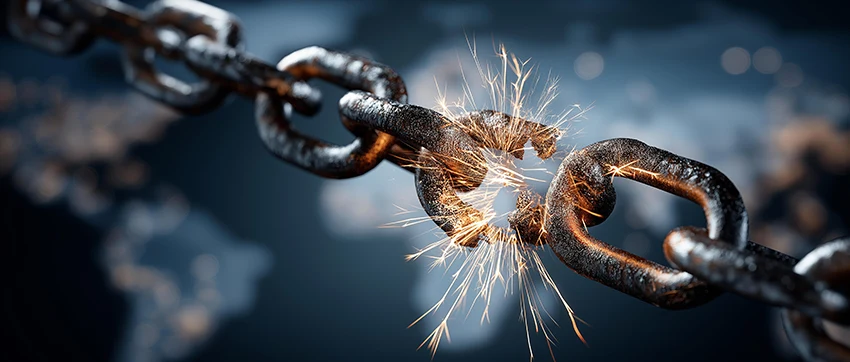
In 2026, disruption isn’t the exception; it’s the operating environment.
The Return of Disruption. Or Did It Ever Leave?
Over the past few years, supply chains have faced:
- Geopolitical instability
- Trade policy shifts
- Port congestion and rerouting
- Labor shortages
- Capacity imbalances
While some of these pressures eased temporarily, recent developments suggest a clear reality:
Supply chain disruption isn’t going away; it’s becoming more frequent, more complex, and more interconnected.
From tightening freight markets to global trade tensions, the environment is shifting again.
And many organizations are asking the same question:
Are we actually built to handle this?
The Problem Isn’t Disruption. It’s Fragility.
Disruption, by itself, is not new.
What’s new is how exposed many supply chains remain.
Over the last decade, optimization strategies prioritized:
- Lowest cost
- Lean inventory
- Fixed routing structures
- Regionalized operations
These approaches worked well in stable conditions.
But they created a hidden risk:
Efficiency was optimized at the expense of resilience.
So when disruption occurs, the issue isn’t just the event itself; it’s the lack of infrastructure to respond effectively.
Visibility Increased. Resilience Didn’t.
Many companies have invested heavily in:
- Real-time tracking
- Shipment visibility platforms
- Analytics dashboards
And those tools have value.
But they primarily answer one question:
“What’s happening?”
They don’t answer:
- What should we do next?
- How do we adapt quickly?
- How do we protect cost and service simultaneously?
Visibility without action is awareness, not capability.
Where Infrastructure Gaps Start to Show
When disruption hits, weaknesses become clear—fast.
1. Fragmented Systems
- TMS, audit, and analytics operate separately
- Data is delayed or inconsistent
- Decision-making is disconnected
2. Reactive Cost Management
- Costs are reviewed after the fact
- Limited ability to validate rates before execution
- No real-time alignment between planning and financial outcome
3. Static Operating Models
- Fixed routing guides
- Limited provider flexibility
- Difficulty adjusting to changing capacity conditions
4. Regional Limitations
- Lack of global operational consistency
- Time zone delays in issue resolution
- Inconsistent processes across geographies
Disruption doesn’t break strong systems; it exposes weak ones.
What Resilient Infrastructure Actually Looks Like
Organizations that perform well during disruption don’t rely on visibility alone.
They build infrastructure designed for adaptation, not stability.
That includes:
Integrated Operational and Financial Systems
- Planning, execution, and audit connected
- Continuous validation of cost and performance
- No lag between action and financial insight
Real-Time Decision Capability
- Ability to compare rates dynamically
- Flexibility to shift providers based on conditions
- Immediate response to market changes
Global Operational Coverage
- Support across regions and time zones
- Consistent processes and governance
- Faster issue resolution
Human Expertise Paired with Technology
- AI for speed and scale
- Experienced teams for exception handling
- Continuous oversight and adjustment
Resilience isn’t about reacting faster, it’s about being structurally prepared to adapt.
The Shift From Efficiency to Resilience
For years, supply chains were designed around optimization:
- Lowest cost
- Fastest route
- Highest utilization
Today, leading organizations are rethinking that model.
They’re prioritizing:
- Flexibility
- Optionality
- Financial control
- Risk mitigation
Because in a disrupted environment:
The lowest-cost plan is rarely the most effective one.
Why This Matters Now
The signals are clear:
- Freight markets are tightening
- Trade routes are shifting
- Cost volatility is increasing
And disruption is no longer isolated, it’s systemic.
Organizations that lack the infrastructure to:
- Adapt quickly
- Validate decisions
- Maintain financial control
Will find themselves:
- Absorbing higher costs
- Struggling with service consistency
- Making reactive, short-term decisions
The Bottom Line
Disruption is not a temporary phase.
It’s a permanent condition of modern supply chains.
And the real question isn’t:
“Can you see disruption coming?”
It’s:
“Are you built to operate effectively when it happens?”