

Parcel shipping is often assumed to be simple. A label is printed, a package moves, an invoice arrives, and payment follows. Compared to truckload or ocean freight, it appears routine, almost automatic.
In reality, parcel shipping is one of the most complex and fast-moving areas of freight transportation. For organizations shipping thousands or millions of parcels each year, small inconsistencies quietly compound into meaningful cost and visibility challenges.
Teams often assume parcel costs are predictable, until monthly invoices spike and no one can clearly explain why.
This is why parcel freight audit, long treated as an afterthought, is becoming an essential intelligence function within modern supply chains.
What Is Parcel Freight Audit and Why Does It Exist?

Parcel freight audit is the process of validating parcel transportation provider invoices to confirm that charges on the invoice align with provider negotiated rates, service levels, dimensional weight rules, fuel schedules, accessorials, and delivery commitments.
Parcel invoices are rule-heavy by nature. A single shipment can be affected by zone logic, package dimensions, weight thresholds, residential surcharges, peak fees, address corrections, and service guarantees. At scale, these variables change continuously.
Traditionally, parcel audits focused on identifying billing errors and recovering refunds after invoices were issued. That function remains important, but it is no longer sufficient.
Why has Parcel Audit Evolved Beyond Refund Recovery?
Parcel shipping has become a primary fulfillment channel for many enterprises. E-commerce growth, omnichannel delivery models, and rising customer expectations have dramatically increased parcel volume and complexity.
Invoices now arrive in massive quantities, often weekly or daily, containing millions of line-level data points. Manual review is impractical, and traditional rules-based systems struggle to keep pace with constant changes in carrier pricing logic.
Without effective parcel auditing, organizations lose clarity into true shipping costs, struggle to enforce contract terms, and operate with distorted spend visibility.
As parcel audit expands beyond refund recovery into a control layer for cost accuracy and data integrity, audit discipline at scale has become increasingly important. This shift is also reflected in how leading parcel carriers evaluate audit capabilities. nVision Global has been a FedEx-certified parcel auditor since 2023, maintaining that designation through 2024 and 2025, and achieving full certification in 2026. This reflects the ability to accurately interpret complex parcel pricing logic and maintain trusted data across high-volume shipping environments.
Parcel audit is no longer just an accounting activity, it has become a control layer for cost accuracy, service enforcement, and fulfillment insight.
The Hidden Challenge: Parcel Data at Scale
Some enterprises already have parcel contracts, transportation provider portals, and reporting tools. Yet many still struggle to answer basic questions with confidence.
- Are dimensional rules being applied correctly?
- Are accessorial charges consistent with contract terms?
- Are service failures being identified accurately?
- The challenge is not access to data, it is confidence in the data.
Parcel invoices arrive in structured, semi-structured, and unstructured formats. Legacy OCR tools can extract values, but they do not understand contractual intent, dimensional logic, or service-level nuance. Errors pass quietly into reporting systems, weakening analytics and decision-making downstream.
Solving this challenge requires more than extraction, it requires systems that understand parcel logic at scale.
How AI Is Redefining Parcel Audit?
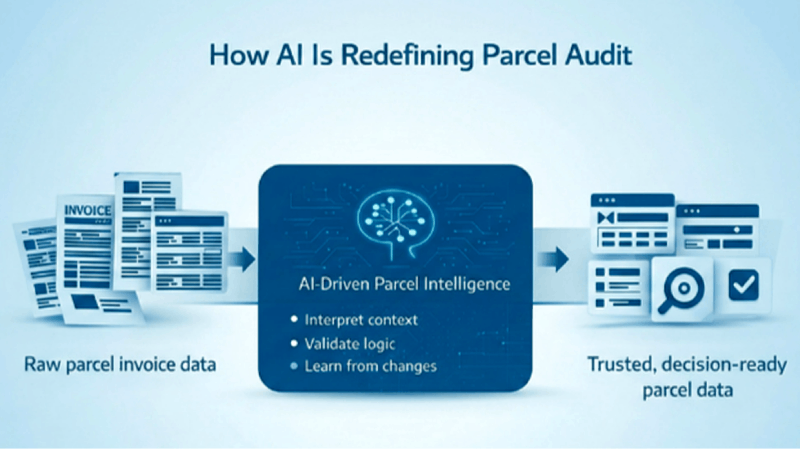
Modern parcel audit requires intelligence, not just extraction.
AI-driven data intelligence platforms, such as nSure AI Data Extraction within the nVision ecosystem, interpret parcel invoices in full operational and contractual context. They classify charges, validate dimensional and zone logic, normalize data, and continuously learn from evolving transportation provider behavior.
Instead of relying on static rules that require constant maintenance, AI adapts as pricing structures change. Parcel audit shifts from reactive refund identification to proactive data validation and insight generation.
The result is clean, trusted parcel data that can support analytics, transportation provider negotiations, and fulfillment strategy.
From Transaction Review to Parcel Intelligence
As parcel audit becomes integrated with analytics and procurement processes, its value expands. Validated audit data highlights patterns in dimensional weight impact, accessorial usage, service performance, and zone-based cost behavior.
Organizations gain earlier visibility into cost drivers, stronger enforcement of contract terms, and clearer insight into how parcel decisions affect overall fulfillment economics. Parcel audit becomes a feedback loop, informing strategy rather than simply validating transactions.
What once occurred quietly after billing now plays an active role in shaping future shipping decisions.
Final Thought
Parcel shipping may appear operationally simple, but at scale it is one of the most data-intensive components of the supply chain.
As volumes grow and pricing structures become more complex, parcel audit, powered by AI-driven data intelligence such as nVision Global’s nSure AI Data Extraction, is emerging as a foundational capability for organizations that want accuracy, visibility, and control.
For high-volume shippers, the smartest parcel strategies don’t start with renegotiation or new transportation providers, they start with intelligence at the invoice level.