

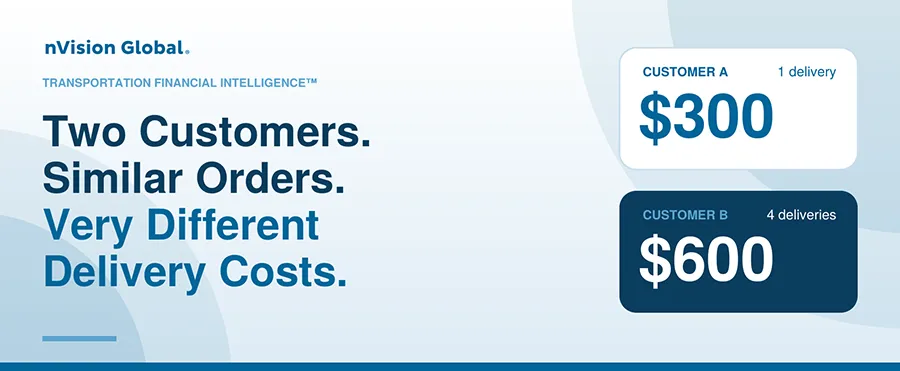
How delivery frequency, receiving requirements, and service commitments influence the transportation expense behind an order.
Two customers order the same quantity of the same product. Their destinations are comparable, and the orders generate the same revenue. Yet fulfilling one customer’s delivery requirements costs considerably more.
The difference may begin with how the orders are delivered. One customer accepts a single scheduled shipment. The other needs several deliveries or a service that includes additional handling. Similar sales activity can create different transportation demands.
nVision Global’s freight spend analytics and broader transportation management and freight audit and payment services provide relevant perspectives for examining those differences. Shipment information and billed charges help teams understand the transportation expense associated with serving a customer. Commercial and operating teams explain the requirements behind it.
Transportation Financial Intelligence™ connects those perspectives with a practical business question: what transportation work does this customer commitment require, and does the business understand its cost? The answer can inform planning and service discussions without assuming that every higher-cost requirement should be removed.
1. Start With the Delivery Commitment Behind the Order
An order’s product quantity does not describe everything transportation must do. Delivery frequency, required arrival dates, receiving windows, and handling conditions can affect the services needed to fulfill it.
Some requirements are essential to the customer’s operation. Others reflect a preference, an old instruction, or a commitment made when the business relationship began. Establish which conditions apply before comparing costs or proposing a change.
Sales, customer service, and logistics may each hold part of the explanation. The person arranging the shipment may know the instructions but have limited authority to change them. The person managing the relationship may not see the resulting transportation charges.
Bring those perspectives together around a defined customer or group of orders. The initial goal is to understand the agreed service and the work required to provide it.
2. Follow Two Similar Orders Through Different Delivery Arrangements
Consider a hypothetical example involving two customers. Each buys 100 units of the same product during a month, with comparable destinations and shipment conditions except for the delivery arrangements described below.
Customer A accepts all 100 units in one scheduled delivery costing $300. Customer B receives four deliveries of 25 units, each costing $150. The figures are illustrative transportation charges, assumed to include the applicable services for these movements.
| Monthly activity | Customer A | Customer B |
|---|---|---|
| Product quantity | 100 units | 100 units |
| Delivery arrangement | One delivery of 100 units | Four deliveries of 25 units |
| Transportation expense | $300 | $600 |
| Transportation cost per unit | $3 | $6 |
The business ships the same quantity to each customer, but Customer B’s arrangement costs $300 more in transportation for the month. That difference comes from the stated delivery arrangements in this simplified example. It is not a customer result or a general prediction about split deliveries.
The average charge per delivery tells a different story: $300 for Customer A and $150 for Customer B. Looking only at that measure could make Customer B appear less expensive to serve. The full monthly activity and a relevant unit measure reveal the additional transportation expense.
The example still does not establish which arrangement is better for the business. Customer B may need frequent deliveries because of storage constraints or another valid requirement. The next step is to understand that requirement and any alternatives.
3. Identify What Is Driving the Difference
Delivery frequency is one possible cause. Appointment requirements, special equipment, or additional handling can also influence charges. A narrow delivery window may limit suitable services, while changes after booking can create further expense.
Separate these factors where the available records allow it. Distinguish recurring requirements from unusual events and identify whether the customer requested the service or an internal practice created the need.
For example, four deliveries might reflect a customer’s agreed replenishment schedule. They might also result from goods becoming ready at different times or orders being released separately. The visible shipment pattern can be similar while the appropriate response differs.
Avoid treating the cost difference itself as evidence of an error. A charge can be accurate and a service necessary. Understanding its cause gives the business a better basis for planning and discussion.
4. Build a Comparison That Reflects the Work
Choose a comparison that fits the question. Cost per delivery helps explain individual movements. Transportation cost per unit or per order may be more useful when examining the expense associated with fulfilling demand.
Use consistent definitions of quantity, period, and included charges. An order split across several shipments needs a different treatment from several unrelated orders. Confirm that shipment and customer references support the grouping rather than assuming every record maps cleanly.
Account for material differences in product characteristics, distance, mode, and service. Comparing a local standard delivery with an international movement requiring specialized handling will not isolate the effect of customer requirements.
nVision’s freight spend analytics supports examining transportation information by dimensions such as service, mode, location, and destination address. Those views can help focus a review. A complete customer-level analysis may also require order and commercial information from the business.
5. Put the Cost in Front of the People Who Own the Commitment
A transportation team may identify the expense without controlling the customer promise that caused it. Share the finding with the people responsible for that commitment before proposing changes.
The discussion can begin with the requirement and its documented transportation effect. In the example, the useful question is whether four monthly deliveries are necessary and whether another schedule could work for both parties.
Possible responses include maintaining the arrangement, testing a revised schedule, or improving internal readiness so that planned deliveries remain practical. Any commercial response belongs with the relevant account and finance teams, informed by the wider customer relationship.
Transportation expense is one part of serving a customer. It does not establish customer profitability on its own. Product margins, other service costs, and commercial considerations remain relevant to that broader judgment.
6. Evaluate Alternatives Before Calling the Difference Savings
The $300 difference in the example is a comparison of stated transportation expense. It becomes a potential improvement only if a workable change can reduce that expense while satisfying the relevant requirements.
Fewer deliveries may require more inventory or receiving space at the customer. A larger shipment may need different handling or transportation. Include those effects in the evaluation where they matter.
Define the shipments eligible for a trial and the service outcomes to maintain. Compare actual charges after the change with a reasonable baseline, allowing for differences in volume, pricing, and shipment characteristics.
A trial may confirm a useful improvement or show that the existing arrangement remains appropriate. Recording the result helps future teams understand why the business chose its service approach.
7. Use Transportation Financial Intelligence to Make the Commitment Understandable
Customer requirements can become routine instructions long before their transportation effects receive a broader review. Connecting those instructions with shipment activity and billed charges gives the business a more useful explanation of expense.
nVision Global’s ecosystem addresses planning, transportation execution, freight audit, and spending analysis. These perspectives help frame questions about what service was intended, what occurred, and what the business paid. People responsible for the customer relationship provide the context needed to interpret the findings.
Transportation Financial Intelligence™ brings those questions into the same discussion. The outcome may be a revised shipping practice, a better forecast, or a supported decision to continue providing a more demanding service.
Understand the Transportation Work Behind the Sale
Similar orders can require different delivery work. Reviewing the complete activity helps the business understand those differences and discuss them with the right people.
Start with one recurring customer requirement. Establish the transportation expense associated with it, confirm why it exists, and consider whether a practical alternative deserves evaluation. That gives a service commitment a financial explanation the business can use.
Frequently Asked Questions
Can similar customer orders create different freight costs?
Yes. Delivery frequency, receiving conditions, and service requirements can change the transportation work required, even where product quantities are similar.
Does higher transportation expense mean a customer is unprofitable?
No. Transportation expense contributes to the wider cost picture, but customer profitability requires other costs and commercial information. A delivery arrangement may also support a valid business objective.
Which measure should be used to compare customer delivery costs?
Use a measure appropriate to the question and review the underlying activity. Cost per delivery, per order, and per unit can tell different stories, especially when orders are split across shipments.
How does nVision Global fit into this analysis?
nVision’s transportation management, freight audit, and analytics services provide perspectives on shipment activity and expense. Transportation Financial Intelligence™ connects those perspectives with the business requirements behind a delivery commitment.